
Biography
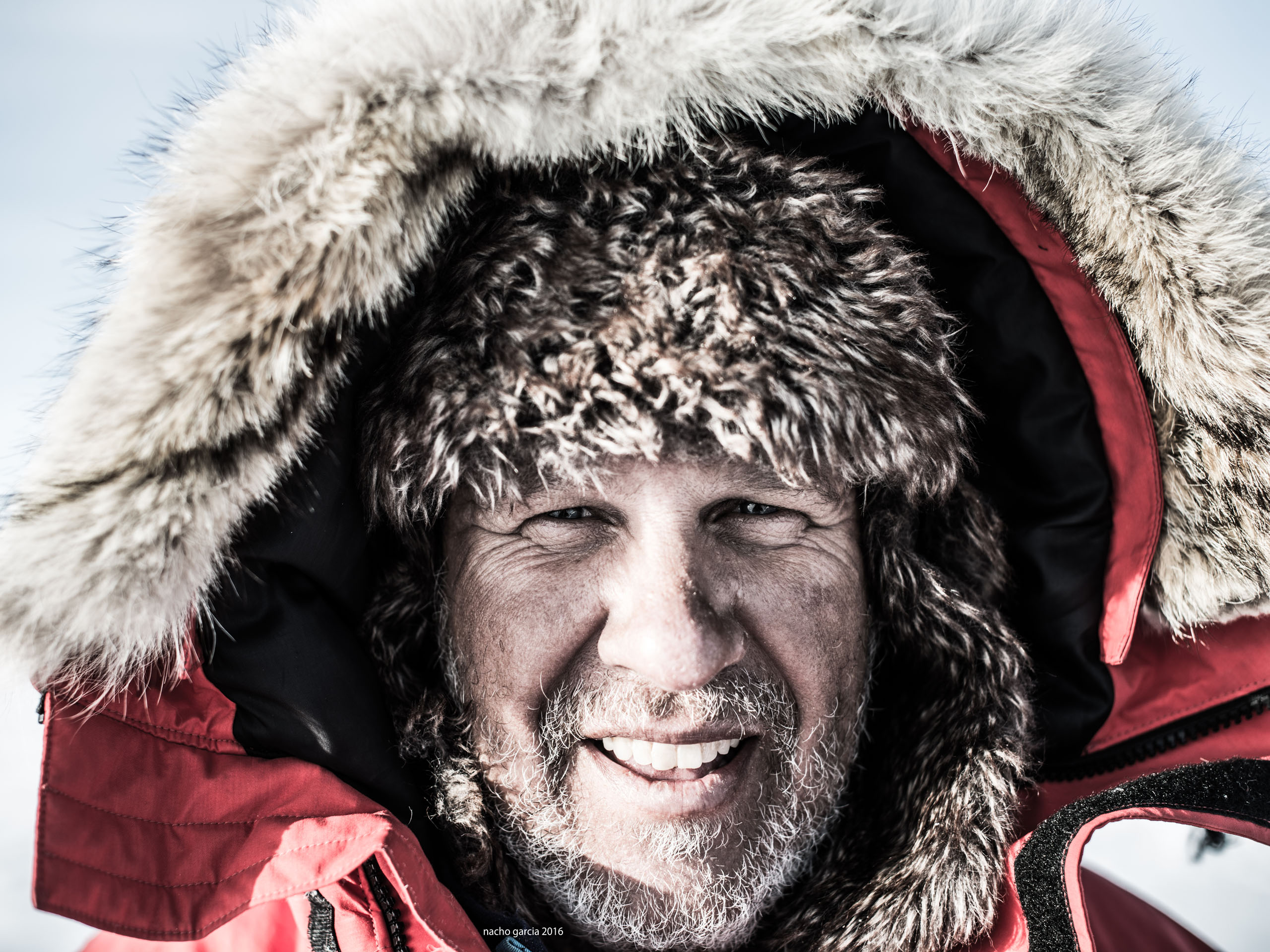
Biography
Born in Madrid in 1965, Ramón has travelled more than 25,000 miles during his career in the polar regions. He has led the most important Spanish polar expeditions carried out to date.
In 1997, he founded Tierras Polares, the first Spanish travel agency specialised in expeditions and journeys to the polar regions. Later, in 2005, he founded Tasermiut South Greenland Expeditions, a company based in Narsarsuaq, Greenland, dedicated to logistics, expeditions and travel in South Greenland.
Ramón has lived for more than 12 years in the Arctic and currently divides his time between Madrid, Reykjavík and Narsarsuaq. He speaks Spanish, French, English, Greenlandic and Danish.
Polar Expeditions
With over 40 years of experience in polar territories, Ramón has completed and led more than 20 major polar expeditions and over 50 smaller journeys in Arctic and Antarctic regions. His work focuses on traditional Inuit knowledge, survival techniques and sustainable exploration.
He is the inventor of the Windsled, a unique ecological vehicle that combines traditional Inuit sled design with modern technology. The Windsled is capable of travelling efficiently across the vast ice plateaus of Greenland and Antarctica and is currently the only zero-emissions transport system designed specifically for clean polar exploration.
A Unique Path
Ramón’s path as an explorer has been original and unconventional. From the Circumpolar Expedition to the development of the Inuit Windsled, his approach has often been misunderstood. This, together with his modest, discreet personality and lack of interest in publicity, explains why his achievements are not widely known.
From Downtown Madrid to the Polar World
Born in the centre of Madrid and the son of a prominent Spanish businessman, Ramón did not grow up surrounded by nature. However, at the age of 14 he began exploring the mountains of the Sierra de Madrid, where his connection with the natural world started.
At 19, together with school friends, he crossed the Pyrenees in winter on skis, from the Atlantic to the Mediterranean. Shortly afterwards, with the support of a friend’s father who was working in Iceland, they organised and successfully crossed the interior of Iceland on skis and pulks, travelling across its three main glaciers.
Crossing Greenland and First Contact with Inuit Culture
After the successful Iceland crossing, Ramón and his friends won a national radio contest organised by Nestlé called “Tu aventura vale un millón” (“Your adventure is worth a million”), aimed at supporting the best Spanish adventure project. Their proposal — the crossing of the Greenland Ice Cap on skis — was selected, and the expedition was successfully completed in 1986.
While waiting in Kangerlussuaq to return to Copenhagen, they met Ejnar Berthelsen, a Danish teacher and school principal from Aasiaat. He invited them to visit him the following winter, and in 1987 Ramón and his friend José Bellido spent three months in Aasiaat. There, Ramón had his first deep contact with Greenlandic culture and dog sledding.
In the house where they lived, a large poster of the Inuit Circumpolar Conference showed a map of the North American Arctic and its Inuit communities. This image inspired Ramón to imagine what would later become the Circumpolar Expedition: a journey across the entire North American Arctic, linking Inuit communities using only dog sleds and kayaks.
To gain experience, Ramón undertook two major sea-kayak expeditions. In 1988, he circumnavigated the Iberian Peninsula, covering around 3,500 km by kayak. In 1989, he paddled the coast of Norway from north to south, travelling approximately 2,500 km. These journeys prepared him for his most ambitious project.
The Circumpolar Expedition
With very limited experience in dog sledding, Ramón embarked on what would become the most important expedition of his life: the crossing of the American Arctic from Greenland to Alaska using dog sleds and kayaks.
The expedition lasted three years. It began in 1990 with a winter spent in the Ilulissat and Uummannaq areas, where Ramón learned dog sledding, sea-ice travel and the Greenlandic language. During the summer, he kayaked the west coast of Greenland from Narsarsuaq to Uummannaq.
After another winter in Uummannaq, the expedition continued by dog sled along Greenland’s northwest coast, crossing the Nares Strait and Ellesmere Island to the Eureka weather station, and then south to Resolute Bay in Canada. After an unsuccessful attempt to kayak the Northwest Passage, the team wintered at the remote outpost of Creswell Bay on Somerset Island.
In the winter of 1992, the journey continued by dog sled all the way to Inuvik. The final stage involved kayaking around Alaska and crossing the interior of the state, finishing in Valdez — a symbolic location in Spanish exploration history as the northernmost point reached by Spanish explorers in the 18th century.
North Pole Expeditions
After returning from the Circumpolar Expedition, Ramón was invited by Spanish television to join two major polar expeditions on skis. In 1998, he skied to the North Magnetic Pole, and in 1999 he reached the Geographic North Pole from Siberia. This became the only Spanish expedition ever to reach the North Pole entirely from land.
It was during this expedition that Ramón first conceived the idea of creating a sled capable of navigating the ice caps of Greenland and Antarctica using wind power.
The First Wind-Powered Crossings of Greenland and Antarctica
The Windsled project was born from the need to solve one of the great challenges of polar travel: moving efficiently across ice caps without emissions. The objective was clear — to achieve the first zero-emissions crossing of Antarctica.
Initial tests were carried out at Lake Bouillouses in the Pyrenees, followed by trials on Great Slave Lake in Canada in the winter of 2000. These experiments led to the first successful crossing of Greenland using the Windsled in the summer of 2000.
The concept was based on a modified Inuit sled, creating an articulated platform capable of carrying a fully mounted tent, pulled by a kite. Its potential was evident from the very beginning. Several Greenland crossings followed, refining the technique.
Finally, in 2005–2006, Ramón completed the first wind-powered, zero-emissions navigation across Antarctica. At the time, this achievement received little attention and was not fully understood by the exploration community, which was largely focused on speed and distance records. Traditional materials, wooden sleds and knot-based construction were seen as outdated in a high-tech world.
With perspective, this expedition can be considered one of the most significant polar achievements of the 21st century, marking the beginning of a new era of sustainable exploration.