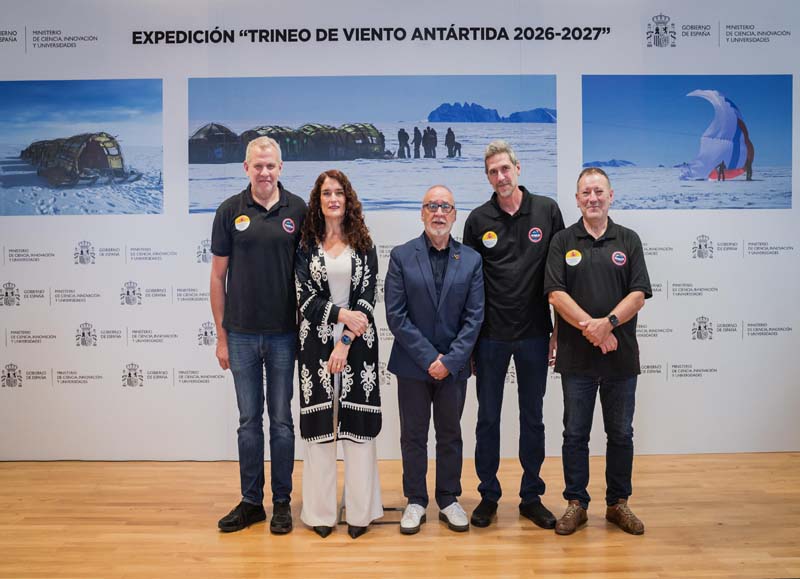
The official presentation of the Windsled Antarctica 2026–2027 Expedition marks the beginning of a new chapter in Spanish polar science.
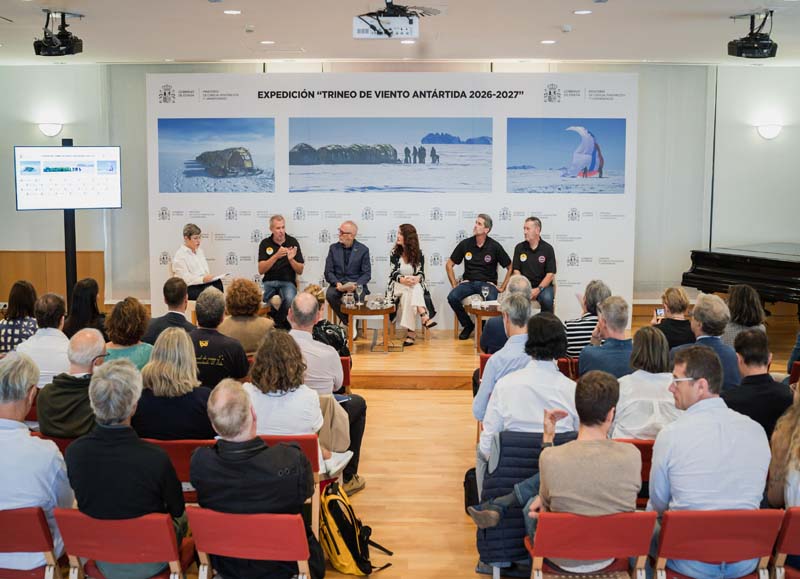
The official presentation of the Windsled Antarctica 2026–2027 Expedition was a great success. Even before the event began, extra seats had to be added to the auditorium of the CSIC Student Residence, the venue chosen by the Spanish Ministry of Science, Innovation and Universities for the event, held on October 7, 2026. Everyone wanted to hear from the authorities and the expedition members as they unveiled the key details of the pioneering scientific journey they are about to undertake.
Surrounded by members of the scientific community—many of whom are directly involved in the expedition—Secretary of State for Science Juan Cruz Cigudosa and Secretary General for Research and President of the Spanish Polar Committee Eva Ortega officially launched the scientific campaign. As Ortega pointed out, the expedition coincides with a special anniversary: 40 years since Spain’s first Antarctic campaign. It also represents a major step forward in Spanish polar research by exploring the interior of the continent through a 3,400-kilometre traverse, transporting scientific equipment to collect data for 16 scientific research projects, most of them Spanish, together with several international collaborations.
The event featured a roundtable discussion moderated by journalist Pampa Molina, Director and Coordinator of the Science Media Centre Spain (SMC). She invited Ramón Larramendi—leader of the Windsled Antarctica 2026–2027 Expedition—to explain the origins of the vehicle, tracing its development back to his landmark Circumpolar Expedition (1990–1993), during which he travelled 14,000 kilometres from Greenland to Alaska without using engines. It was during that journey, he explained, that he discovered the advantages of combining the ancestral knowledge of the Inuit with modern technology. The result is a sophisticated mobile laboratory mounted on wooden runners, travelling across the frozen deserts powered by the wind through traction kites and operating on photovoltaic energy. Zero emissions for efficient and effective polar science, as demonstrated by the more than 28,000 kilometres already travelled by the Windsled.
Secretary of State Juan Cruz Cigudosa highlighted the significance of an expedition whose €500,000 budget is remarkably modest when compared with motorised scientific expeditions carried out by other countries—which are themselves relatively rare. Those missions often require transporting thousands of litres of fuel (up to 170,000 litres in one of the most recent examples) to power large vehicles, sometimes while supporting fewer scientific projects. “This expedition will leave no environmental footprint,” he said. “That is a matter of consistency because we are going to study the condition of the ice, observe how the Sun behaves in Antarctica, and investigate how humans can live in extreme environments, such as those that may exist on the Moon or Mars—all while using a structure that produces no pollution. We are changing the paradigm with decisions that will endure as a highly significant contribution to global science. It is possible to conduct frontier science with zero environmental impact.”
Eva Ortega expressed similar views, emphasizing that this will be the first official Spanish Antarctic campaign to conduct scientific research both from Spain’s two Antarctic bases and across the interior of the frozen continent.
Expedition member Hilo Moreno was responsible for explaining the scientific challenge involved in carrying out 16 research projects during the expedition.
“A great deal of work has already been done together with the researchers to develop the instruments we will be carrying, ensuring that they can withstand the cold and potential impacts. During the expedition itself, one of the new aspects will be the need to stop at precisely defined locations for specific scientific projects. That is why we have divided the programme into three categories: five projects will operate continuously, collecting data 24 hours a day; another three will be carried out intermittently every three or four days; and finally, we will make five dedicated stops—what we call stations—where we will collect samples or carry out surveys for another eight research projects.”
Javier Selva spoke about the human dimension of living together in complete isolation.
“This places us at the forefront of the polar science that Spain contributes to the world. Today we have wind research and communication technologies that did not exist before and that make expeditions like this possible. Even so, our presence there—isolated and living together for almost three months—will itself become an experiment that expands our understanding of this type of journey.”
Pampa Molina invited each participant to share a wish for the expedition. They all agreed that the most important objective is for the expedition to conclude successfully and, above all, for everyone to return safely having achieved their scientific goals.
“This is the beginning of a new future, and I simply wish them the very best of luck,” said Eva Ortega.
Many of the scientific institutions involved in the expedition, together with researchers based in Madrid, attended the event. Numerous media outlets were also present, eager to meet three of the four expedition members and speak with the scientists who have entrusted their research projects to this unique mission. The event was also attended by Eloísa del Pino, President of the Spanish National Research Council (CSIC), along with other leading figures from the Spanish polar science community.
From this point forward, only the final preparations remain before the team departs on October 18. After that, the expedition can be followed closely through its expedition diary on this website.
The expedition will be led by Spanish polar explorer Ramón Larramendi and will include three other specialists: Hilo Moreno, Mariusz Potocki, and Javier Selva.